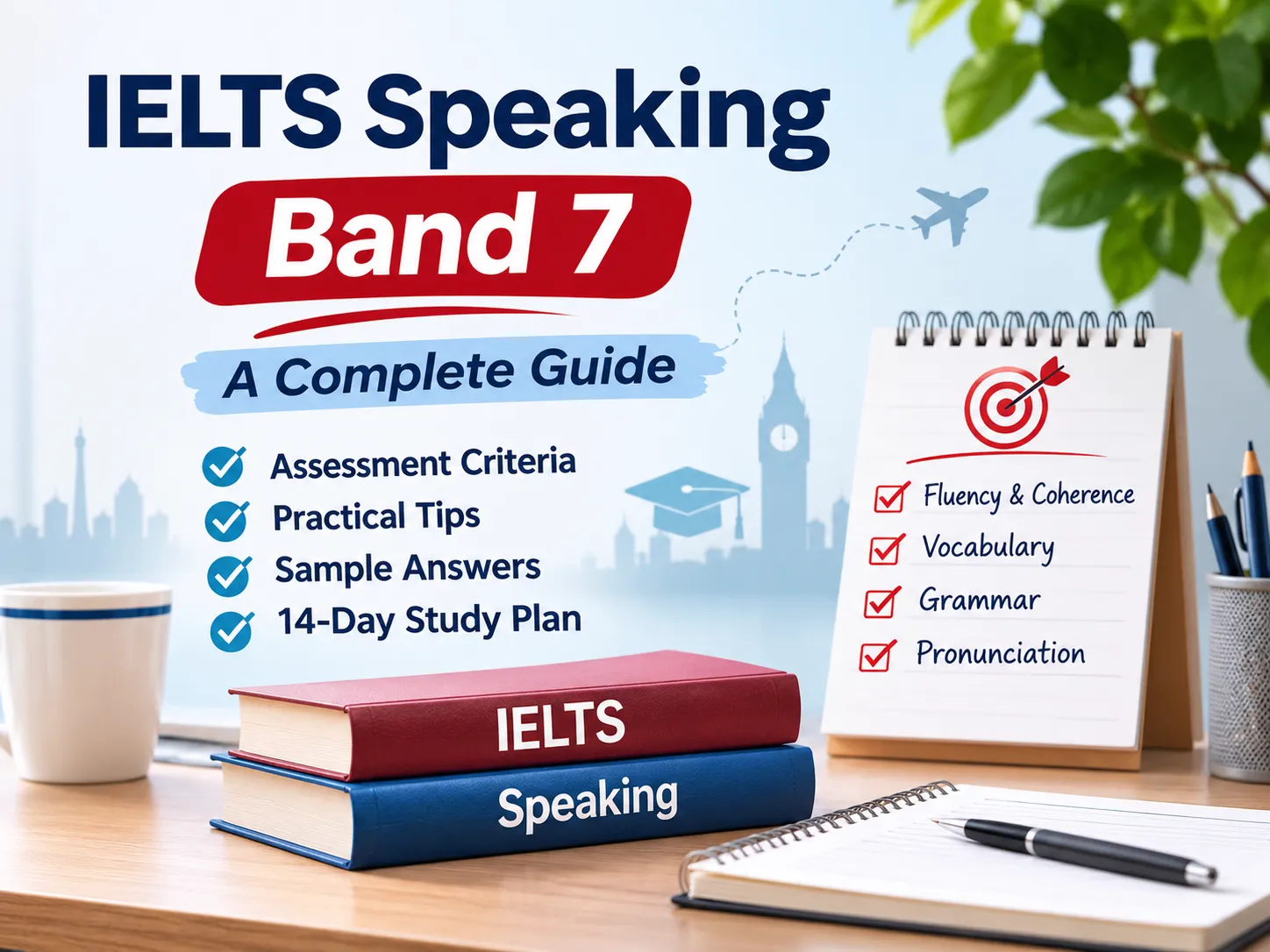
How to Achieve IELTS Speaking Band 7: Tips & Examples
Achieving IELTS Speaking Band 7 is an important goal for students planning to study or work abroad. However, getting this score requires more than memorizing vocabulary or practicing common questions.
To achieve Band 7, you need to speak fluently, develop your ideas clearly, use appropriate vocabulary, and demonstrate good grammatical control and pronunciation.
This guide explains the official assessment criteria, practical preparation strategies, and sample answers to help you improve your IELTS Speaking performance.
What Does IELTS Speaking Band 7 Mean?
IELTS Speaking Band 7 represents a good level of spoken English. Candidates at this level can discuss different topics, explain their opinions, and communicate effectively despite occasional mistakes.
The IELTS Speaking test lasts approximately 11–14 minutes and consists of three parts:
- Part 1: Questions about familiar topics.
- Part 2: A two-minute individual speaking task, with one minute to prepare.
- Part 3: A discussion involving opinions and broader ideas.
Understanding the test structure helps you prepare more effectively.
IELTS Speaking Band 7 Assessment Criteria
IELTS examiners evaluate speaking performance using four equally weighted criteria.
| Assessment Criteria | What You Need for Band 7 |
| Fluency and Coherence | Speak at length while maintaining logical connections between ideas. |
| Lexical Resource | Use vocabulary flexibly and explain ideas using alternative expressions. |
| Grammatical Range and Accuracy | Use a range of grammatical structures with frequent accurate sentences. |
| Pronunciation | Communicate clearly using effective pronunciation, stress, and intonation. |
Important: You don’t need a British or American accent to achieve Band 7. Clear and understandable pronunciation matters more.
5 Practical Tips to Achieve IELTS Speaking Band 7
- Improve Your Fluency
Practice answering questions without excessive hesitation.
Try organizing your responses using:
Opinion → Reason → Example
For example:
Question: Do you enjoy learning English?
“Yes, I particularly enjoy learning English because it allows me to communicate with people from different backgrounds. For example, I’ve recently started watching educational videos in English to improve my listening and speaking skills.”
- Expand Your Vocabulary Naturally
Avoid memorizing complicated words without understanding how to use them.
Instead of saying:
“Studying abroad is very good.”
Try:
“Studying abroad can provide valuable opportunities for personal growth and cultural exchange.”
Use vocabulary that fits the topic naturally.
- Practice Complex Grammar
Band 7 requires flexibility in using grammatical structures.
For example:
Simple: “I study English. I want to attend university abroad.”
Improved: “I’m studying English because I hope to attend university abroad, where I can develop my academic and communication skills.”
Focus on accuracy rather than using unnecessarily complicated sentences.
- Improve Pronunciation
Record yourself answering IELTS questions and listen for pronunciation problems.
Pay attention to:
- Word stress.
- Sentence stress.
- Intonation.
- Speaking rhythm.
You can also practice shadowing, which involves listening to a short English recording and repeating it while imitating the speaker’s pronunciation.
- Take Mock Speaking Tests
Practice under realistic exam conditions.
Use a timer and complete all three speaking sections.
After each practice test, review your performance and identify areas that need improvement.
Feedback from a qualified IELTS instructor can help you recognize mistakes that are difficult to identify independently.
IELTS Speaking Band 7 Sample Answer
Question: Do you prefer studying alone or with other people?
Sample Answer:
“I generally prefer studying alone because I can concentrate better without distractions. However, when I’m preparing for important exams, I sometimes study with friends so we can exchange ideas and discuss difficult topics. I think both methods are useful, depending on what I’m studying.”
Why Is This a Useful Answer?
The response demonstrates:
- A clear opinion.
- Relevant supporting details.
- Natural vocabulary.
- A combination of grammatical structures.
Remember that a written response cannot guarantee a particular IELTS Speaking score. Your pronunciation, fluency, and delivery also affect the result.
IELTS Speaking Band 6 vs Band 7
The main difference between Band 6 and Band 7 is greater flexibility and control when communicating.
| Band 6 | Band 7 |
| May lose coherence while speaking at length. | Can speak at length without losing coherence. |
| Vocabulary is generally sufficient but less flexible. | Uses vocabulary more flexibly. |
| Complex grammar may be limited or less accurate. | Uses a wider range of structures more flexibly. |
| Pronunciation is generally understandable. | Demonstrates stronger control of pronunciation features. |
These are simplified comparisons based on the official IELTS Speaking Band Descriptors.
14-Day IELTS Speaking Preparation Plan
If your exam is approaching, follow this structured study plan:
| Days | Preparation Focus |
| 1–3 | Assess your speaking level and improve fluency. |
| 4–6 | Practice vocabulary, grammar, and pronunciation. |
| 7–9 | Focus on IELTS Speaking Parts 1 and 2. |
| 10–12 | Practice Part 3 discussions and mock tests. |
| 13–14 | Review mistakes and complete a final speaking simulation. |
Try practicing for 30–60 minutes daily, depending on your current level and schedule.
A 14-day study plan can help organize your preparation, but it does not guarantee Band 7.
Frequently Asked Questions
Can I get IELTS Speaking Band 7 without perfect English?
Yes. Occasional mistakes are acceptable, provided you demonstrate sufficient fluency, vocabulary, grammatical control, and pronunciation.
How long does it take to achieve Band 7?
Preparation time depends on your current English level. Some students need targeted practice, while others require longer-term language development.
Can I prepare for IELTS Speaking online?
Yes. Online lessons, speaking practice, official IELTS resources, and instructor feedback can support your preparation.
Prepare for IELTS with Capstone Learning
Achieving IELTS Speaking Band 7 requires consistent practice, clear communication, and an understanding of the official scoring criteria.
At Capstone Learning, students can explore IELTS preparation options to support their academic and professional goals.
Explore our IELTS Preparation Course to learn more about the available learning options.
Official reference: IELTS Speaking Band Descriptors